Let’s Start From the Beginning.
If you’ve recently learned that your child qualifies for an Individualized Education Program (IEP), you may be feeling excited, overwhelmed, uncertain—or all three at once.
Those feelings are completely normal.
The world of special education introduces new terms, unfamiliar paperwork, and many questions. It can feel like learning a new language overnight.
Whether you’re preparing for your first IEP meeting or you’ve attended several over the years, my hope is that this website helps you better understand your child’s educational journey while strengthening the connection between home and school.
You don’t have to know everything today.
We’ll simply take it one step at a time.
What Is an IEP?
An Individualized Education Program (IEP) is a personalized plan created to support your child’s unique learning needs.
Think of it as a roadmap.
It helps the IEP team understand where your child is today, where they are working toward over the next year, and the individualized supports that will help them make meaningful educational progress.
Every IEP is unique because every child is unique.
Rather than focusing only on challenges, an IEP also recognizes strengths, celebrates growth, and creates a plan that builds upon your child’s individual abilities and potential.
Most importantly, an IEP is not simply a school document. It is a shared plan developed through collaboration between families and educators, all working toward the same goal: helping your child learn, grow, and thrive.
Understanding the Special Education Journey
Every family’s journey is different, but most follow a similar path.
It often begins when a parent or teacher notices that a child may need additional support. Assessments help the team better understand your child’s strengths and areas of need.
If your child qualifies for special education services, the IEP team—including you—works together to create an individualized plan.
Throughout the year, teachers and specialists provide services, monitor progress, and celebrate growth.
Each year, the team meets again to review progress, update goals, and adjust supports as your child continues to grow. Approximately every three years, a reevaluation helps determine whether your child’s educational needs have changed and whether they continue to qualify for special education services.
This process isn’t about labels. It’s about ensuring your child receives the support they need to succeed.
Home and School: Better Together
An IEP is strongest when families and educators work together.
Families know their child in ways that no assessment can fully capture—their personality, interests, routines, motivations, and the little victories that happen outside of school.
Teachers and specialists bring expertise in instruction, child development, assessment, and individualized supports.
When these perspectives come together through open communication and mutual trust, children benefit from greater consistency, stronger relationships, and more meaningful progress.
Partnership doesn’t mean doing the exact same things at home and at school. It means moving in the same direction.
From Meeting to Meaning
For many families, the IEP meeting lasts about an hour.
Then everyone goes home.
Teachers return to their classrooms.
Therapists continue working with students.
The paperwork is filed away.
As a parent, you may leave carrying a copy of your child’s IEP and quietly wonder,
“Now what?”
If you’ve ever felt that way, you’re not alone.
The IEP isn’t meant to stay in a binder until next year’s meeting. It’s meant to guide the support your child receives throughout the year—and that includes the opportunities to encourage learning, communication, independence, and confidence at home.
Each section of your child’s IEP tells an important part of their story.
Present levels help us understand where your child is today.
Annual goals identify the skills your child is working toward over the next year.
Accommodations describe supports that help your child access learning successfully, and many of those same supports can be incorporated into everyday family routines.
Related services such as speech therapy, occupational therapy, counseling, or adapted physical education often provide ideas that can be naturally reinforced outside of school.
An IEP isn’t simply paperwork.
It’s a shared plan connecting the people who care about your child most.
Learning Happens Every Day
Children don’t stop learning when they leave school.
They learn while setting the table, helping make dinner, reading bedtime stories, shopping at the grocery store, getting dressed, playing games, talking in the car, and spending time with family.
Some of the most meaningful learning happens during these everyday moments.
Those moments don’t have to feel like homework. They simply become opportunities to practice the same skills your child is already developing at school.
Celebrate Every Step Forward
Progress doesn’t always happen in big leaps.
Sometimes growth looks like trying something new, asking for help instead of becoming frustrated, using a new word during dinner, waiting patiently for a turn, following a routine independently, greeting a friend, zipping a jacket, or writing a name.
Every small success is worth celebrating.
Small steps often become life’s biggest milestones.
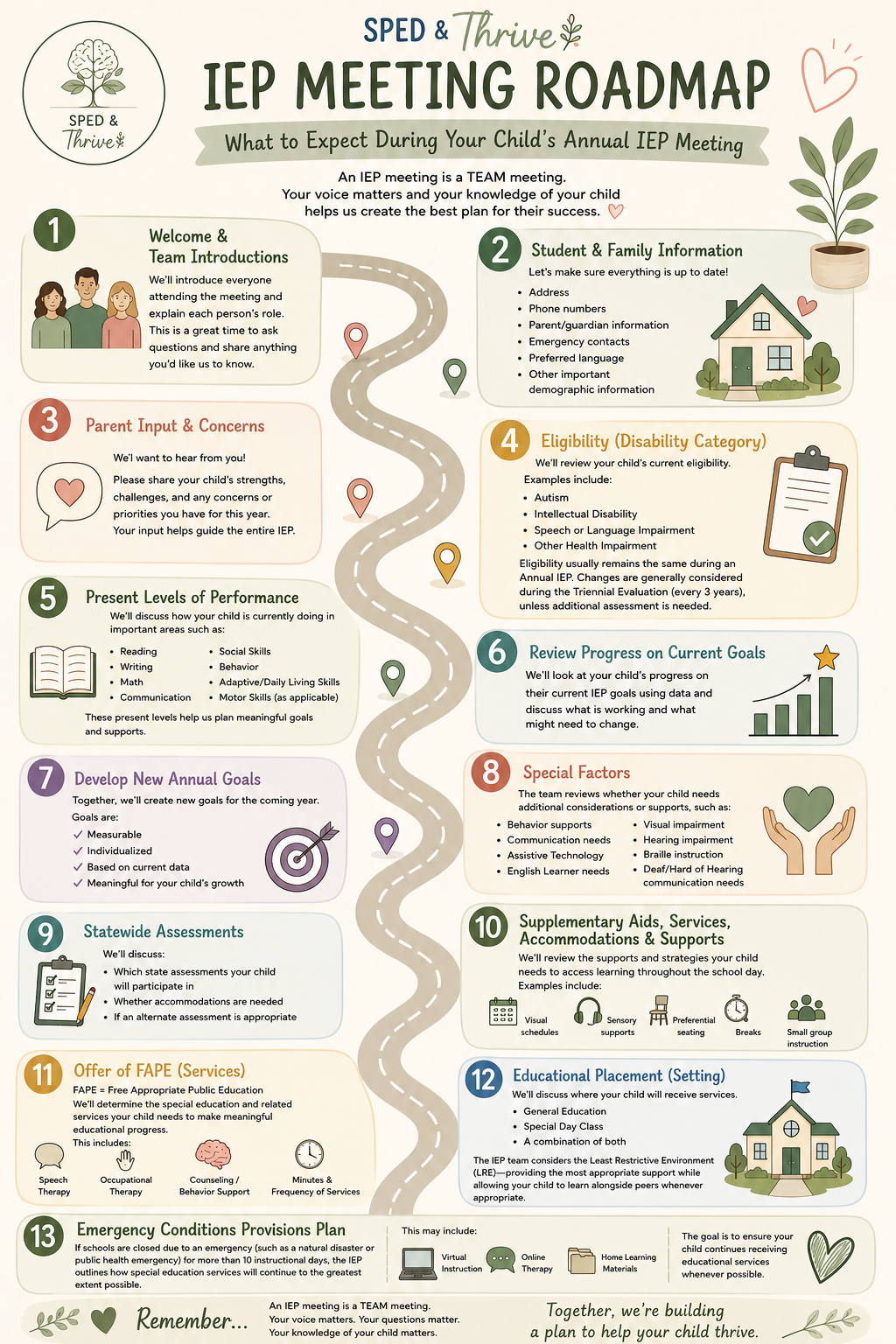
Annual IEP Map Overview
If there’s a topic you’d like to learn more about, I’d love to hear from you.
Contact Me → spedandthrive@gmail.com
A Final Thought
Meaningful progress happens when families and schools work together.
Thank you for being an advocate, a partner, and a source of support for the children in your life.